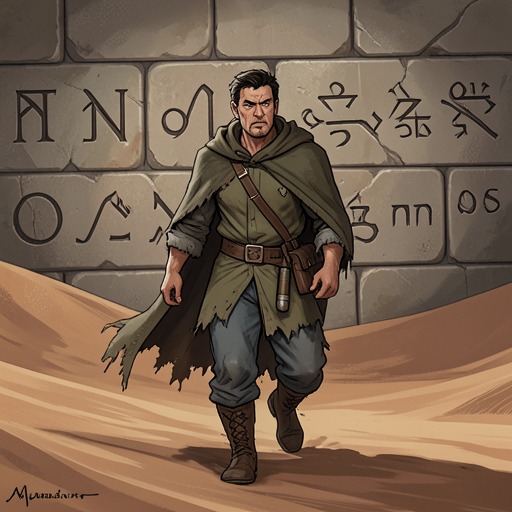
Lestat’s first death and rescue by Marius
The Vampire LestatLestat’s first death and rescue by Marius marks the passage from Lestat’s near-total physical collapse to his restoration by an older vampire whose power and apparent compassion distinguish him from the dangers Lestat has known. Buried in the earth and unwilling to surrender to thirst, Lestat dwindles until he can no longer rise; then a sound seeks him out, Marius finds him, and offers blood. The rescue is at once bodily renewal and recognition: Lestat names the stranger, and Marius confirms his identity.
Causes and Background
The episode’s emotional burden reaches back to Lestat’s life among the living. Born the youngest of the sons who survived to manhood in a once-wealthy family, he had no inheritance or prospects. His father’s estate in Auvergne, in the final decades before the French Revolution, was his narrow world; with the family’s resources depleted, Lestat hunted to help feed them. That early role as provider contrasts with his later helplessness beneath the earth: the young hunter who once supplied his household cannot now move himself to safety.
His family’s financial decline also narrowed the future available to him. Augustin made clear that Lestat had been sent to learn to read and write, not to pursue a church career befitting the family’s rank. There was no money to make him a bishop or cardinal, and he was expected to accept a life of limited means and family duty. Lestat’s grief at supper, where he called the household “chaos,” reveals how deeply that confinement wounded him. The later crisis therefore follows a life shaped by constraint, frustrated ambition, and separation from the prospects he had imagined.
In Paris, the theater offered a counterworld to that inherited disappointment. The boulevard theaters were outside the government-sanctioned houses, which held the monopoly on serious drama, yet they drew audiences from both poor spectators and wealthy patrons. Lestat immersed himself in the lively performances and the practical work around them, learning by memorizing, mimicking, and asking questions. Nicolas played violin in the theater; his brief solo each night was part of the shared life Lestat valued. The memory of applause and Nicolas’s question about making people happy returns in the buried Lestat’s thoughts, carrying the vanished human world into his ordeal.
That human world is violently broken by the Revolution. On July 14, the Paris mob attacked the Bastille, and unrest spread through France. A letter reports that peasants and tenant farmers rose against Lestat’s father’s house: his brothers, their wives and children, and those who defended the castle were killed before it was looted. Only his father escaped, reaching New Orleans in the former French colony of Louisiana and pleading for Lestat to come to him. The news places the burial and its aftermath against a second devastation: the loss of the family and home that had defined Lestat’s mortal life.
Buried in the Earth
Lestat believes he is dying, but the account renders his condition as prolonged endurance rather than a clean ending. He cannot count the nights. He knows he must rise and travel to Alexandria, yet movement would mean turning over in the earth and yielding to thirst. He refuses. The thirst comes and recedes, while his heart continues to beat with an agony he cannot escape.
The refusal has a terrible consequence. Lestat becomes, in his own description, little more than thirst lying underground, trapped in red sleep and dreams. He grows too weak to push through the sandy soil, and even the possibility of turning over seems beyond him. He continues to breathe and live, but not as a mortal would. His hands have become claws, his flesh has shrunk against his bones, and his eyes bulge from their sockets. The scene establishes that abstaining from blood does not release him from existence: it leaves him conscious of a continuing life reduced to weakness and pain.
Memories make that physical decline inseparable from loss. Lestat thinks of Nicolas as gone, of his brothers as gone, and of the theater’s wine and applause. The remembered exchange about whether their work made people happy carries a different weight under the earth, where Lestat’s survival has become an isolated burden. The question of goodness is not resolved by the scene; instead, the recollection sets the fragile human fellowship of the theater against the loneliness of his present condition.
Marius Finds Him
The change begins when Lestat hears a sound like a cannon boom. He understands that it is searching for him and that he must answer. Though barely able to move his lips, he sends it a welcome and makes known that he is there. The sound grows stronger around him; the earth shifts, and the ruined house above becomes part of the unseen visitor’s approach.
Digging through the sand reaches Lestat before he can free himself. Something soft brushes his face, and he sees the dark sky and clouds overhead. Air and light, which had become inaccessible, return as immediate signs of release. The sound that led Marius to him fades into the aftersound of a violin string. This progression—from the distant, forceful signal to a quieter musical resonance—joins the rescue to Lestat’s remembered life around music without explaining the sound beyond its role as the means by which Marius locates him.
The figure standing over Lestat appears unlike the vampires he has known. Lestat sees a man in red velvet, with a ground-length cloak, red gloves, and thick hair streaked white and gold. His broad face and blue eyes convey an impression of gentleness and peace. Lestat regards the figure’s patience and compassion as qualities foreign to his own kind, even as the stranger lifts him from the earth. The scene’s contrast is decisive: after an ordeal defined by isolation and refusal, rescue arrives through a presence Lestat initially cannot reconcile with vampirism.
Blood and Recognition
Marius tells Lestat to drink, exposing the vein at his throat. The offered blood restores Lestat with a force that reverses his underground wasting: strength gathers in his arms, and the blood spreads through his body. Lestat understands the blood as carrying power accumulated across centuries. The act is not merely a means of escape from the immediate crisis; it binds the weakened vampire to the older one whose blood revives him.
The recognition is spoken plainly at the close of the encounter. Lestat says “Marius,” and the stranger answers “Yes.” In that exchange, the rescuer becomes an identified person rather than an inexplicable presence. Marius has found Lestat, drawn him out, and given him blood; Lestat, restored enough to recognize and address him, receives the answer that confirms their connection.
Consequences and Significance
The rescue reverses the apparent finality of Lestat’s burial without erasing what preceded it. The Revolution has destroyed the family home and killed Lestat’s brothers and their households; Nicolas is also remembered as lost. Marius’s intervention restores Lestat’s capacity to continue, but it does not return him to his former life. The crisis instead opens a new relationship and a new phase in his existence.
As a narrative turning point, the episode places vulnerability at the center of Lestat’s encounter with an ancient vampire. Lestat’s refusal to feed leaves him unable to act, while Marius’s call and offered blood make survival depend on contact with another being. The scene thus shifts the meaning of endurance: Lestat persists beneath the earth, but persistence alone cannot lift him from it. His naming of Marius, followed by Marius’s confirmation, gives the rescue its lasting shape—not only a return from near-death, but the beginning of a bond that will matter to Lestat’s subsequent history.